Georgia sees roughly 30 tornadoes every year, and that number doesn’t include the high-wind events, hailstorms, and heavy rain that roll through North Georgia with little warning. Most business owners think about roofing only when something goes wrong. That’s a costly mistake. Your roof is not just shelter. It’s the single barrier standing between your operations and a storm that could shut you down for weeks. This article breaks down how the right roofing choices defend your property, protect your profits, and keep your business running even after severe weather hits.
Table of Contents
- Why roofing is your first defense against North Georgia’s storms
- How high-performance roofing prevents costly storm damage
- Choosing the right roofing materials: What really lasts in North Georgia?
- Inspection and maintenance: The critical, often-overlooked safety factor
- A local expert’s take: What North Georgia business owners get wrong about roofing safety
- Stay protected: Roofing solutions tailored for North Georgia businesses
- Frequently asked questions
Key Takeaways
| Point | Details |
|---|---|
| Storm-proofing matters | North Georgia’s severe weather demands roofs built for strong wind and hail to prevent costly business damage. |
| High-performance standards win | FM and IBHS compliant roofs greatly outperform basic code roofs in storm survival and minimizing downtime. |
| Material choice is critical | Metal roofing systems have far lower storm damage rates than shingles, saving money over time. |
| Regular maintenance saves cost | Annual inspections and documented repairs significantly reduce disaster risks and insurance problems. |
Why roofing is your first defense against North Georgia’s storms
North Georgia sits in a region where severe weather is not a rare event. It’s a regular reality. Between tornadoes, straight-line winds, and hailstorms, commercial buildings here face repeated stress throughout the year. Understanding what that means for your roof is the first step toward real protection.
The numbers tell a clear story. Georgia averages about 30 tornadoes annually, but wind and hail events far outnumber tornado touchdowns. When a storm hits, your roof takes the full impact first. As noted in commercial roof performance research, roofing serves as the primary barrier protecting commercial buildings from storm damage in North Georgia. Once that barrier fails, water gets in fast.
Water infiltration is where losses multiply. Secondary water damage can amplify total losses by over 30%, turning a manageable repair into a full business interruption. Inventory gets ruined. Equipment fails. Customers go elsewhere. The financial spiral from a single storm event can take months to recover from.
“A roof failure during a storm is rarely just a roofing problem. It becomes an operations problem, a liability problem, and an insurance problem all at once.”
Here’s a quick look at how storm-related roof failures affect businesses:
| Storm impact | Business consequence |
|---|---|
| Water infiltration | Inventory loss, mold, structural damage |
| Wind uplift failure | Roof collapse risk, extended closure |
| Hail damage | Membrane punctures, accelerated aging |
| Debris impact | Structural penetration, safety hazards |
The key takeaways for North Georgia business owners:
- Storm frequency is high. Don’t treat roofing as a one-time decision.
- Water damage compounds fast. A small leak becomes a large loss quickly.
- Business continuity depends on your roof. It’s not just a building component.
Reviewing a commercial roofing checklist before storm season is one of the smartest steps you can take. Our commercial roofing services are built specifically for the demands North Georgia weather places on business properties.
How high-performance roofing prevents costly storm damage
Knowing that your roof matters is one thing. Understanding what actually makes a roof resilient during real storms is another. Not all roofing systems perform equally, and the difference shows up most clearly when severe weather arrives.
Most storm failures don’t start in the middle of a roof. They start at the edges. Wind uplift forces are highest at the perimeter and corners of any commercial building. When edge flashings, fasteners, or seams are not properly secured, the roof begins to peel from the outside in. Once that process starts, it accelerates rapidly.
High-performance systems address this with layered defenses:
- Reinforced edge metal and perimeter fastening to resist uplift forces at vulnerable points
- Sealed roof decks to prevent water intrusion even if the outer membrane is compromised
- Advanced membranes like KEE (Ketone Ethylene Ester) that remain flexible and watertight under extreme temperature swings
- Continuous insulation layers that add structural rigidity and reduce thermal movement
The performance gap between standard and high-performance systems is measurable. FM 1-90 rated systems withstand 90 pounds per square foot of uplift, and sealed decks reduce water intrusion by up to 95%. That’s not a minor improvement. That’s the difference between staying open and shutting down.
The IBHS FORTIFIED program takes this further. Buildings with FORTIFIED-rated roofs experienced up to 70% fewer insurance claims during major storms. That figure alone should make any property manager take notice.
| Roofing standard | Uplift resistance | Water intrusion reduction | Claim reduction |
|---|---|---|---|
| Code minimum | Low | Baseline | Baseline |
| FM 1-90 rated | 90 psf | Up to 95% | Significant |
| IBHS FORTIFIED | High | Very high | Up to 70% |
Using our roofing safety checklist helps you evaluate where your current system stands. And when it’s time to upgrade, choosing a top roofing company with experience in high-performance systems makes all the difference.
Pro Tip: Securing the edges and sealing the deck matters more than the membrane brand. Most storm failures trace back to installation details, not material quality alone.
Choosing the right roofing materials: What really lasts in North Georgia?
Even with the best design and installation standards, your material choice determines how well your roof holds up over time. North Georgia’s climate is demanding. Hot summers, UV exposure, sudden hailstorms, and wind-driven rain all test your roof year after year.
The data on material performance is striking. During Hurricane Ian, metal roofs had a 12% damage rate compared to over 50% for asphalt shingles. That gap is not a fluke. It reflects fundamental differences in how these materials respond to wind, impact, and moisture.
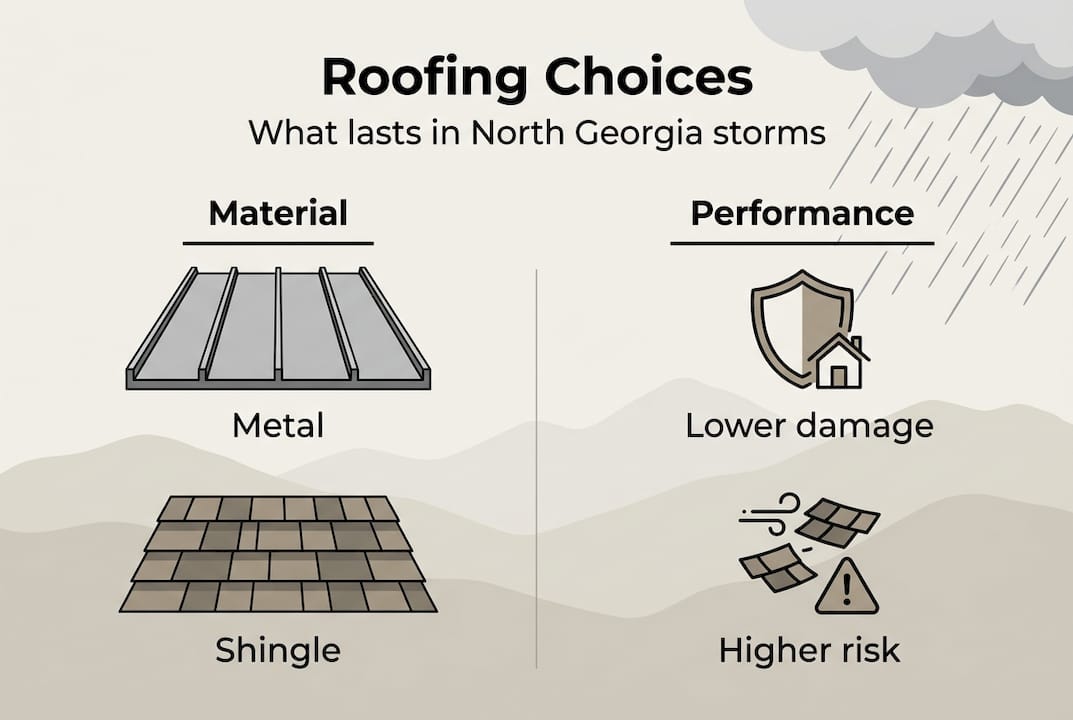
Here’s how the top commercial roofing materials stack up for North Georgia conditions:
Metal roofing
- Pros: Exceptional wind and impact resistance, 40 to 70-year lifespan, low maintenance
- Cons: Higher upfront cost, can be noisy without proper insulation
Asphalt shingles
- Pros: Lower initial cost, widely available, easy to repair
- Cons: Granule loss under UV and hail, higher storm damage rates, shorter lifespan
Single-ply membranes (TPO, EPDM, KEE)
- Pros: Excellent for flat or low-slope commercial roofs, good UV resistance, cost-effective
- Cons: Vulnerable to punctures if not properly maintained, seams require inspection
Material failure modes matter too. Asphalt shingles lose granules over time, which accelerates UV degradation and reduces impact resistance. Wind peel starts at corners and ridges. Membranes can develop seam separations that go unnoticed until water is already inside.
Knowing when to repair versus replace is also critical. If your roof is past 15 to 20 years old, repair costs often exceed the value of the remaining lifespan. Replacement with a higher-performing system is frequently the smarter financial decision. Our storm roof repair guide walks through how to assess damage and decide on the right path forward. For more material comparisons and local tips, visit our roofing blog.
Pro Tip: If your commercial roof is more than 15 years old, it was likely installed under older standards that don’t meet today’s performance benchmarks. An inspection now could prevent a major loss later.
Inspection and maintenance: The critical, often-overlooked safety factor
The best materials and design can still fail if maintenance is neglected. This is where many business owners fall short, not because they don’t care, but because roofing stays out of sight until something goes wrong.
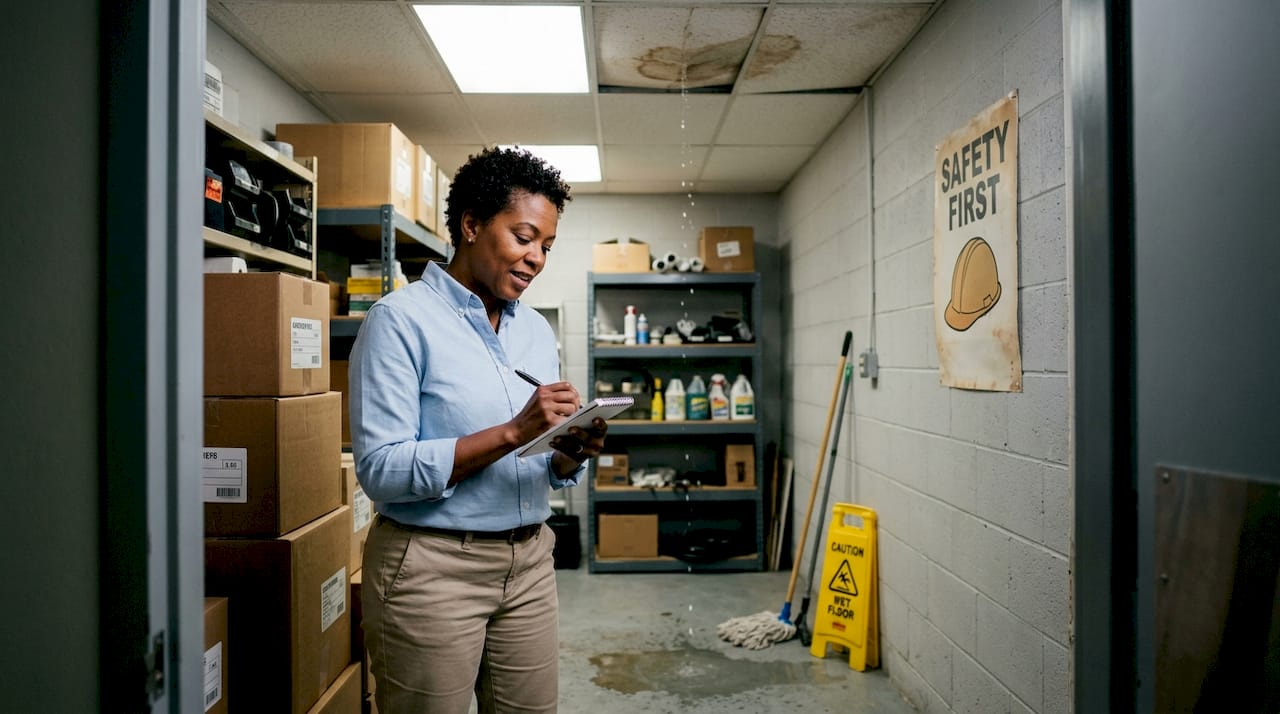
Neglected maintenance causes 24% of all commercial building damage. That’s nearly one in four damage events that could have been prevented with routine care. Annual inspections and timely repairs are not optional expenses. They are risk management.
“The most expensive roof repair is always the one you didn’t see coming. Regular inspections turn surprises into scheduled maintenance.”
Here’s a practical inspection and documentation process for business owners:
- Schedule a professional inspection annually, and always after any storm that produces wind over 50 mph or visible hail
- Inspect interior ceilings and walls for water stains, bubbling paint, or soft spots that signal active leaks
- Check roof drains and gutters for blockages that cause ponding water and accelerate membrane wear
- Document all findings with photos and written notes, including dates and contractor details
- Keep a maintenance log that records every repair, inspection, and material replacement
That last point is more important than most business owners realize. Documented maintenance records directly support insurance claims after storms. Insurers look for evidence that the roof was properly maintained. Without records, claims can be delayed or reduced. With them, you have proof that damage was storm-caused, not neglect-related.
For exterior upkeep that supports roof longevity, professional roof cleaning removes algae, moss, and debris that trap moisture and degrade roofing materials over time. Following roofing maintenance best practices keeps your system performing at its best between major inspections.
Pro Tip: Keep every maintenance invoice and inspection report in a dedicated file. This documentation can lower your insurance premiums and dramatically speed up claims processing after a storm event.
A local expert’s take: What North Georgia business owners get wrong about roofing safety
After years of helping businesses across North Georgia recover from storm losses, we’ve noticed a pattern. Most owners assume that if their roof meets building code, they’re protected. That assumption is wrong, and it’s costly.
Building codes are designed to protect life safety, not business continuity. A code-compliant roof can fail completely in a major storm and still meet every standard it was built to. Codes set a floor, not a ceiling.
The businesses that recover fastest after storms are the ones that invested in FM or IBHS-rated systems. Yes, those systems cost more upfront. But the post-storm inspection data consistently shows that edge details and aging standards are the biggest hidden vulnerabilities. The savings on claims, downtime, and repairs pay back that investment many times over.
We also see a lot of damage that traces back to overlooked details. Old edge metal. Unsealed penetrations. Roofs that were patched repeatedly instead of replaced. These are the failures that shut businesses down. The fix is not complicated. Get a professional assessment, invest in quality materials and installation, and maintain what you have. Work with a team you can trust when identifying a trustworthy roofer for your property.
Stay protected: Roofing solutions tailored for North Georgia businesses
Now that you understand what separates a safe roof from a vulnerable one, the next step is making sure your property is actually covered. Infinity Roofing GA has been serving North Georgia businesses since 2018, and we specialize in exactly the situations described in this article.
From storm damage repair to full commercial replacements, we bring licensed expertise, premium materials, and same-day response to every job. Our team handles insurance claims from start to finish, so you can focus on your business instead of the paperwork. Whether you need a post-storm assessment or a proactive upgrade, our detailed storm roof repair guide and commercial roofing expertise are ready to help. Contact us today for a fast, honest estimate.
Frequently asked questions
How can I tell if my business’s roof is storm-ready?
Schedule a professional inspection focused on wind resistance, edge securement, and material condition, particularly if your roof is over 15 years old or has faced a recent major storm. Older roofs under older standards are especially vulnerable, making post-storm inspections critical.
Is metal roofing really better than shingles for business properties?
Yes. Metal roofs show a 12% damage rate versus over 50% for asphalt shingles in severe storms, making them a far more reliable choice for commercial properties in storm-prone regions like North Georgia.
What maintenance steps lower insurance costs after a storm?
Documented maintenance records demonstrate that damage was storm-caused rather than neglect-related, which can lower your premiums and significantly speed up the claims process after a weather event.
How often should business roofs be inspected?
At a minimum, schedule an inspection once per year, and add an immediate check after any severe weather event. Annual inspections reduce risk and help catch maintenance issues before they become major damage.